



01
Conventional context
Raw trajectories preserve appearance—not intent.
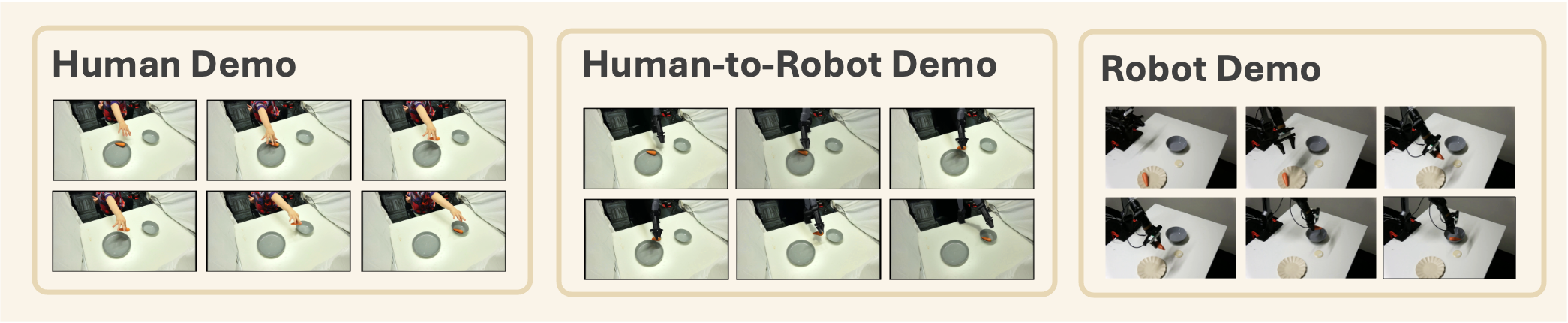
Human, retargeted, and robot demonstrations all record a successful execution, but pixels and continuous actions alone do not explain the procedure that transfers between them.
 Technical report · August 2026
Vision · Language · Action
Learn the why, not just the motion.
In-Context Structured Demonstration for Generalizable Vision-Language-Action Models
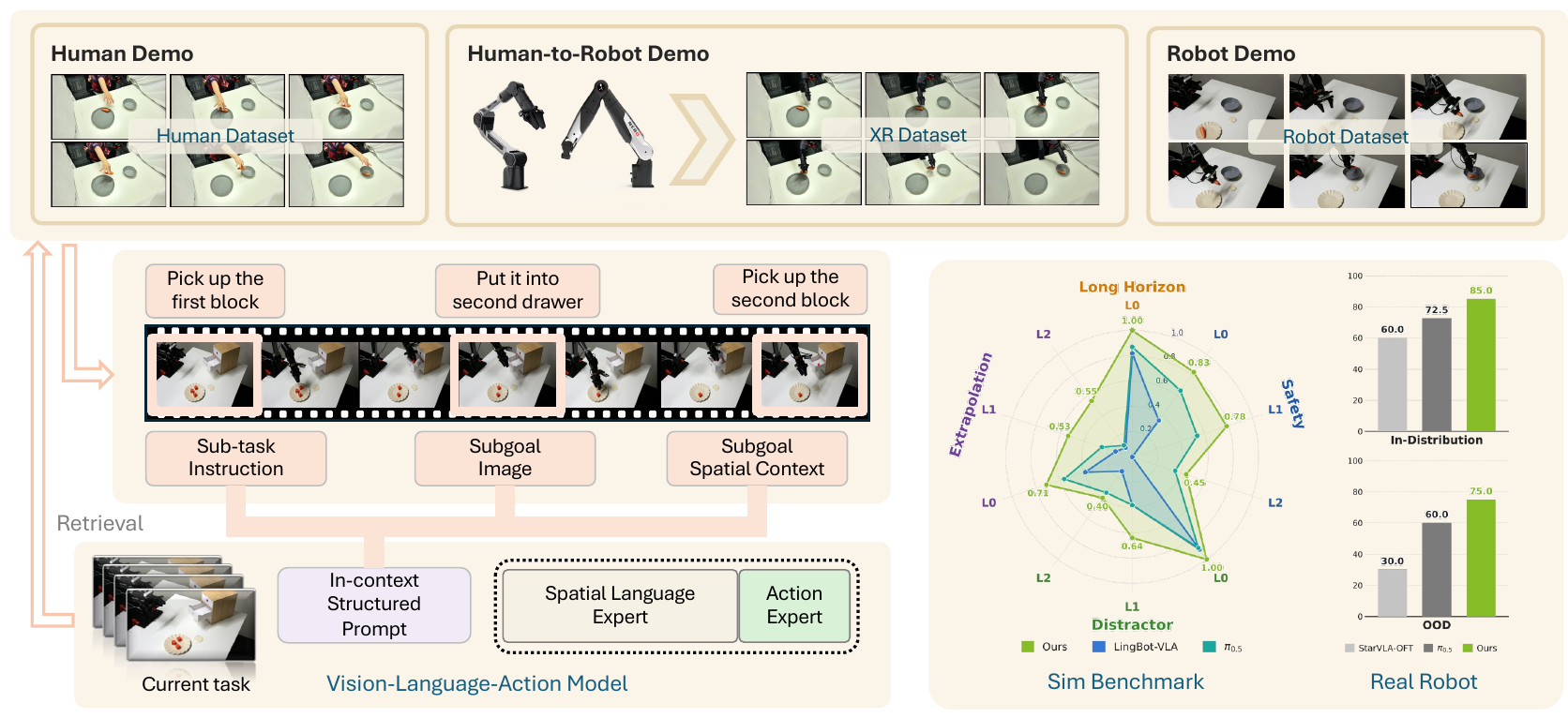
StellaVLA adapts at test time from a single retrieved demonstration. Instead of replaying a trajectory, it transfers the task plan, subgoals, and grounded motion—without fine-tuning or autoregressive language decoding in the control loop.
01 · The idea
Vision-Language-Action models can manipulate familiar objects, but their performance often collapses when the scene, viewpoint, or object changes. Collecting new data and fine-tuning for every new condition does not scale.
In-context imitation learning offers another path: retrieve one expert demonstration and condition the policy on it at test time. Yet raw observations and actions communicate only what an expert did. StellaVLA adds the missing why.
Conventional context
Human, retargeted, and robot demonstrations all record a successful execution, but pixels and continuous actions alone do not explain the procedure that transfers between them.
StellaVLA context
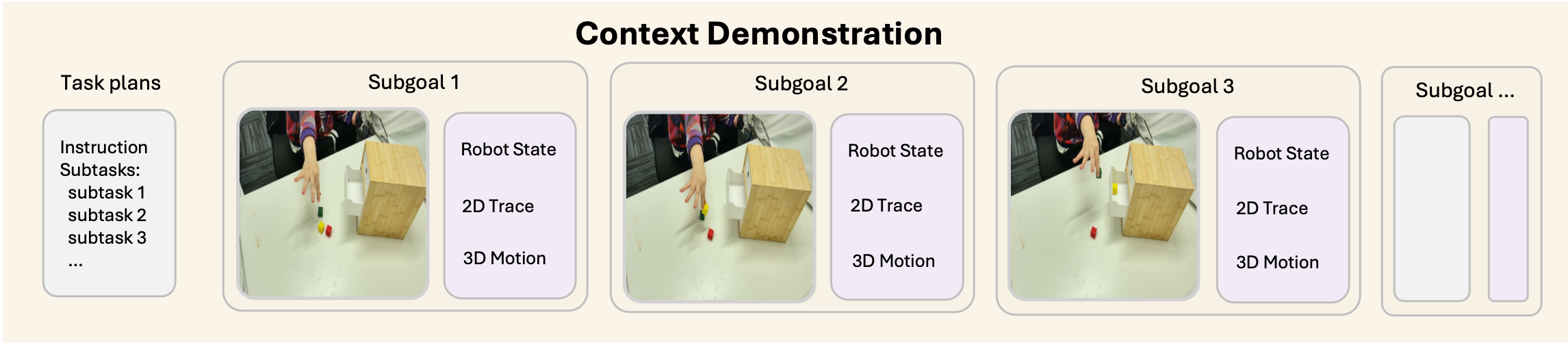
Each keyframe is paired with the current subgoal, robot state, image-grounded 2D trace, and workspace-level 3D motion. The result is a task template instead of a trajectory replay.
“The policy learns to imitate the expert's reasoning, not only its motions.”
02 · Method
A zero-annotation extraction pipeline and an asymmetric train/deploy design connect semantic reasoning to continuous robot control.
Offline context extraction
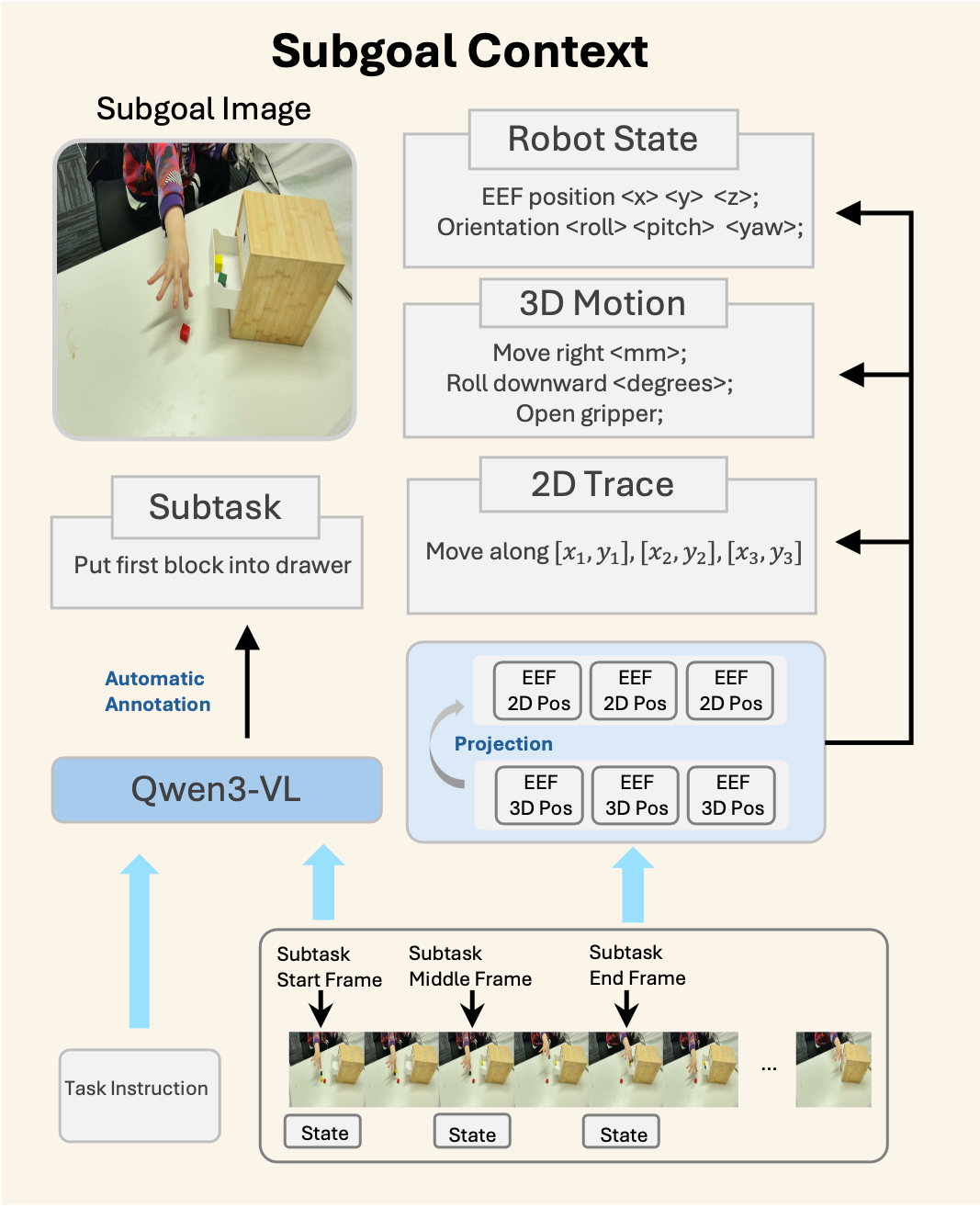
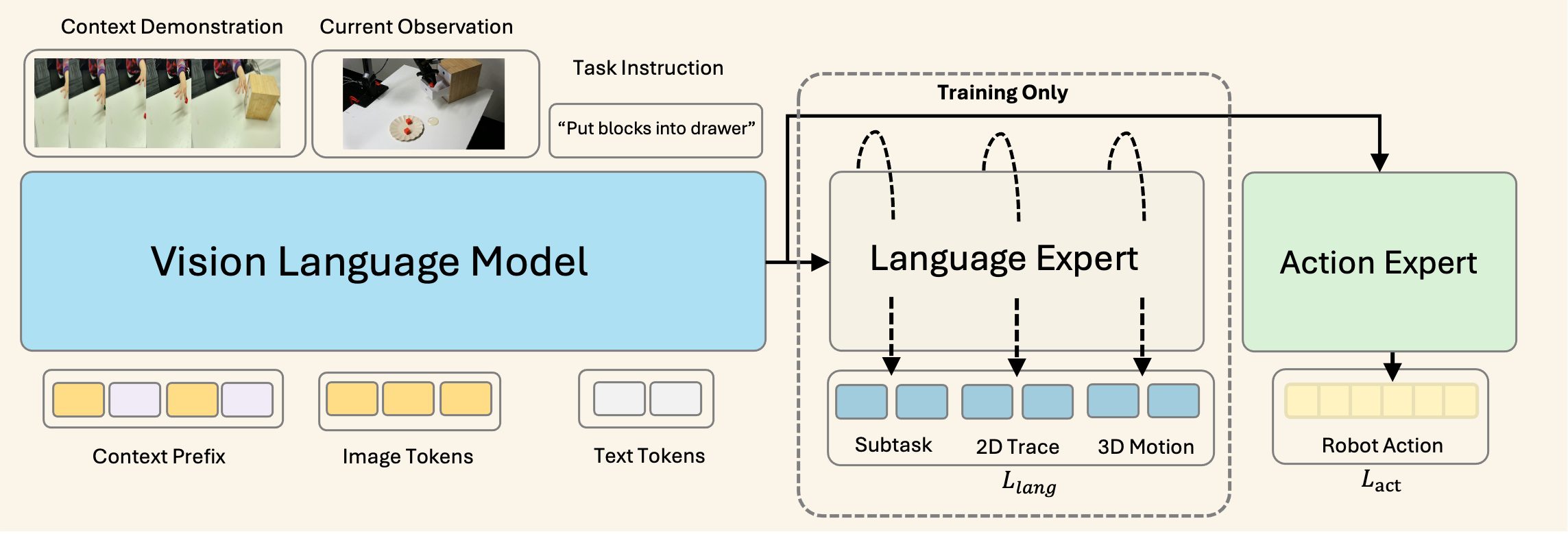
Qwen3-VL segments the trajectory into semantic subgoals. A deterministic verbalizer then projects robot motion into an image-grounded 2D trace and describes its 3D workspace displacement. No manual rationale labels are required.
Parallel dual training
The retrieved context, current observation, and task instruction enter a shared vision-language backbone. The language expert predicts the current subtask and grounded motion while the action expert regresses the continuous action chunk in parallel.
Asymmetric inference
At deployment, StellaVLA keeps only the action path. The fixed demonstration prefix is encoded once and reused throughout the rollout, preserving structured guidance with approximately 2× faster context-conditioned inference.
03 · Results
StellaVLA preserves in-distribution competence while widening the gap under task, visual, and language shifts.
First on the leaderboard as of August 1, 2026, compared with 0.44 for the strongest prior model reported in the technical report.
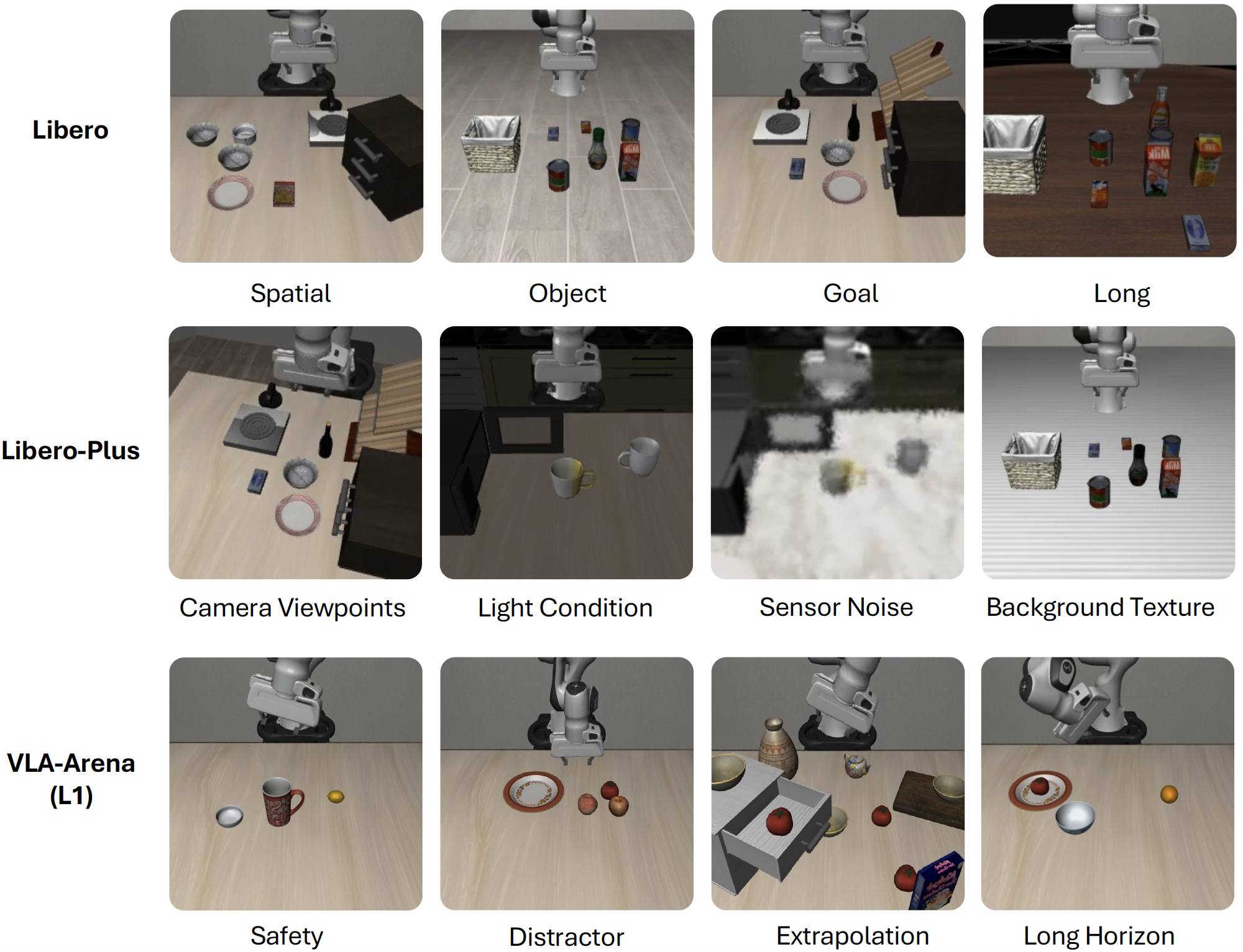
Best average across Spatial, Object, Goal, and Long suites. The largest gains over the matched control appear on Goal and Long, where the current image alone cannot specify intent or order.
+10.1 percentage points over the matched demonstration-free control under camera, robot-state, sensor, layout, background, lighting, and language shifts.
04 · Evidence
Evaluation-time interventions reveal what carries the transferable signal—and when context can mislead the model.
Full four-suite LIBERO average.
The intended task becomes ambiguous.
Mismatched context actively changes behavior.
Text-only context nearly matches image + text on LIBERO, while image-only context falls to 92.9%. Structured language abstracts away source-specific appearance.
Three keyframes reach 98.1%, within 0.7 points of the default ten. The subgoal sequence matters more than dense trajectory replay.
05 · Real world
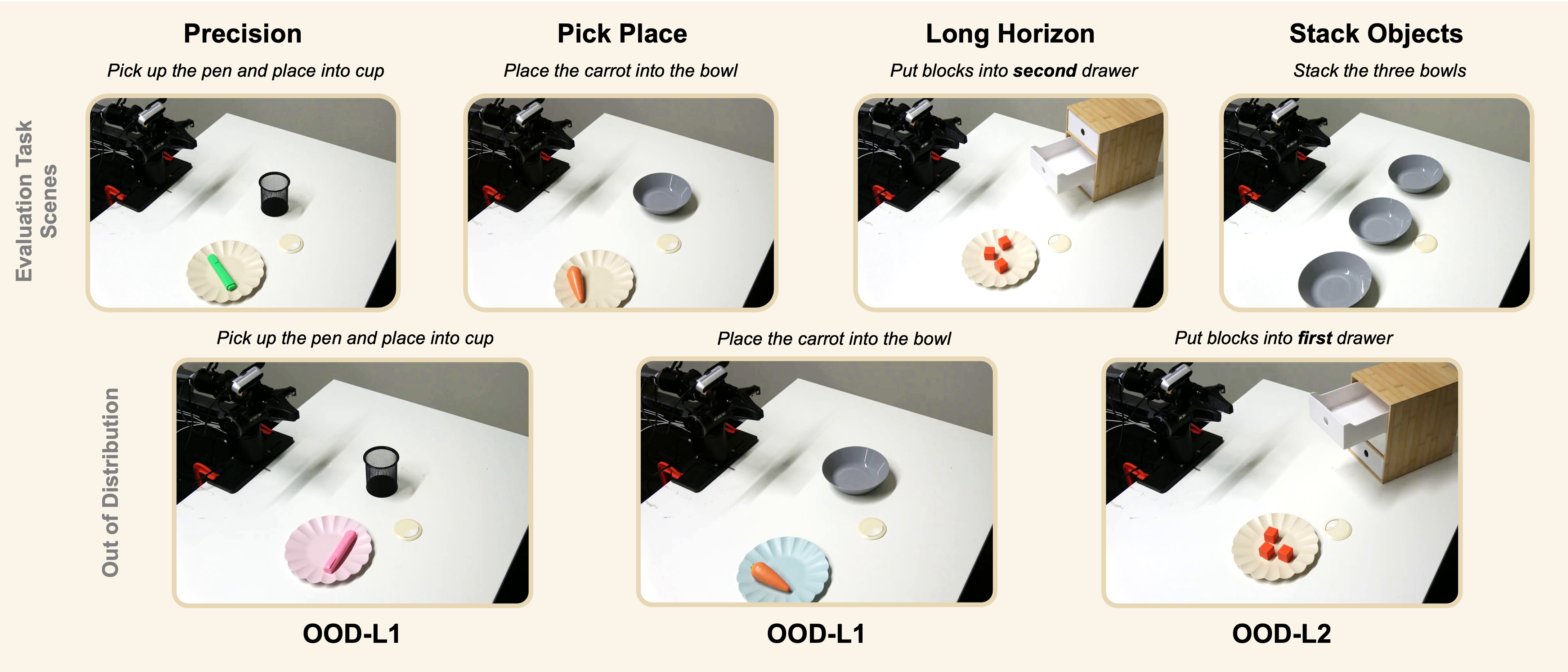
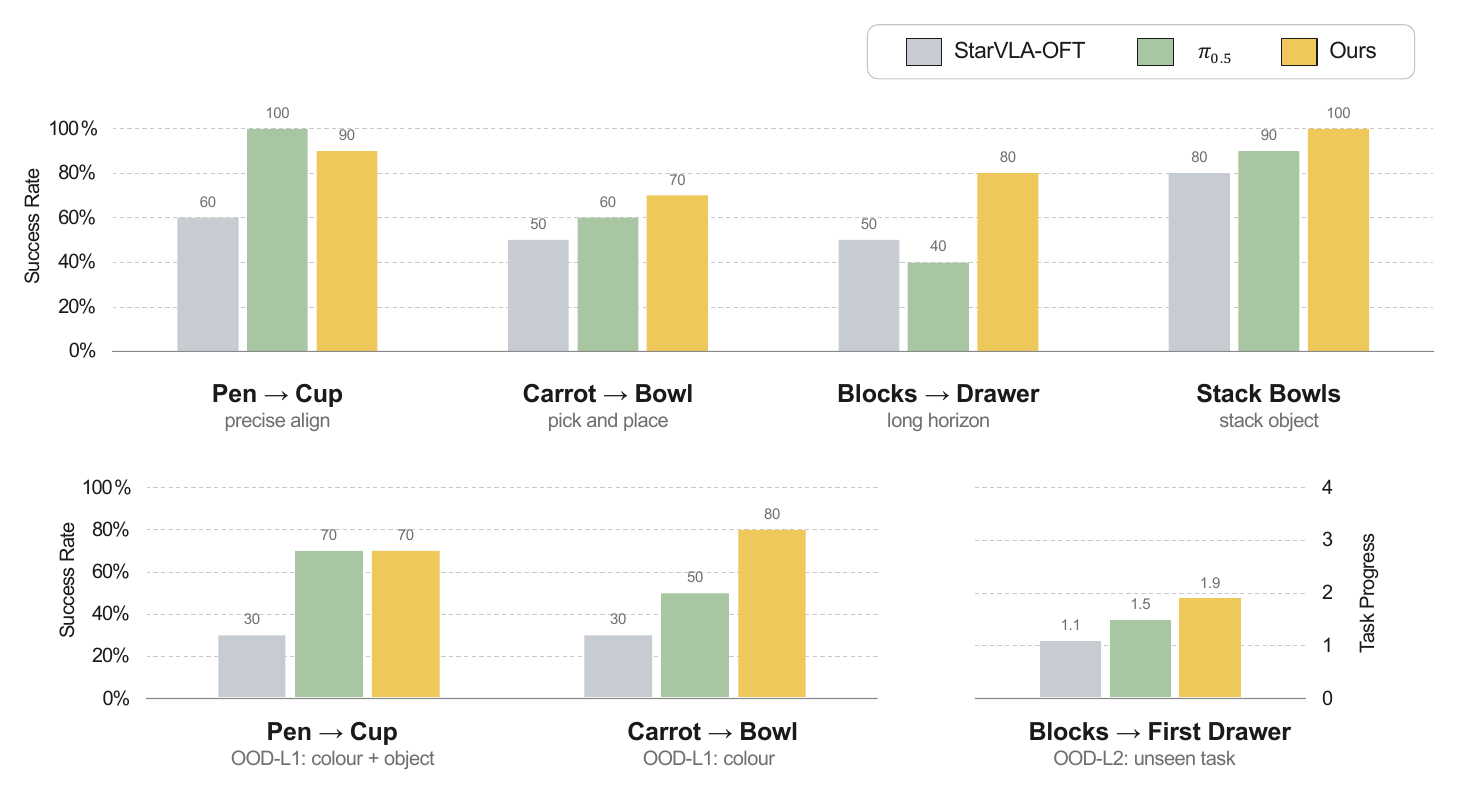
Human-hand, XR-retargeted, and robot demonstrations share the same structured representation, while executable supervision remains in the target robot's native action space.
26 XR-recorded takes
26 frame-aligned robot trajectories
Real-time 6-DOF control
06 · Deployment
Autoregressive rationale decoding is useful supervision, but it is incompatible with a high-frequency control loop. StellaVLA pays the reasoning cost during training, then deploys the action expert alone.
Technical report
In-Context Structured Demonstration for Generalizable Vision-Language-Action Models